The Future of E Shikshakosh Expanding Beyond Bihar
The Future of E-Shikshakosh Expanding Beyond Bihar began as a practical, state-level answer to long-standing problems in school governance fragmented records, slow grievance redressal, opaque teacher-service histories, and inconsistent attendance and learning-data collection.
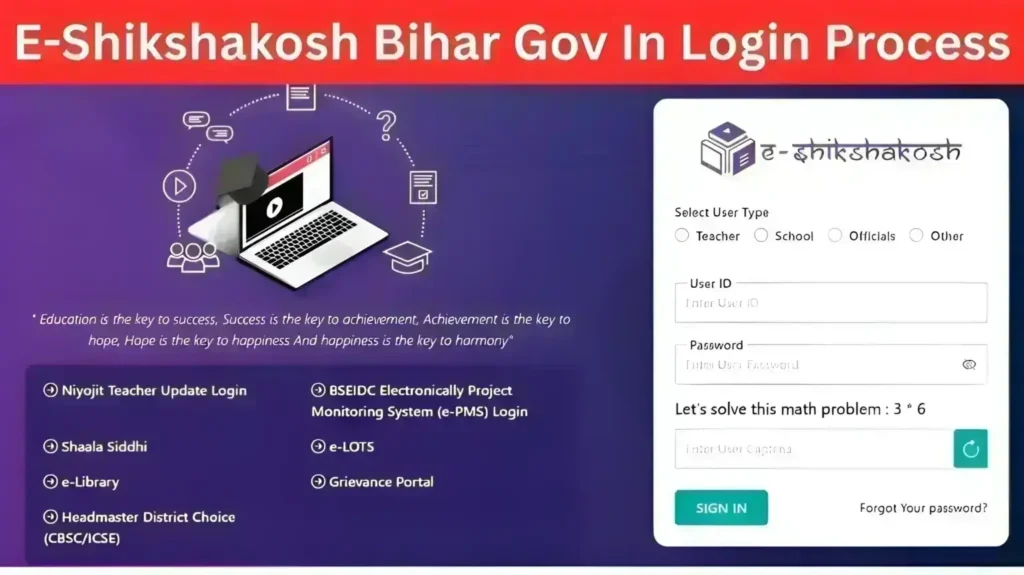
Launched and maintained for Bihar’s education system, the portal centralises teacher profiles, attendance, training records, service history and school data into a single digital ecosystem and it’s already being used for tasks such as e-service books, transfer management, and real-time monitoring.
Key opportunities for national expansion
E Shikshakosh Facilitates Efficient Scholarship and Uniform matters nationally A single, well-designed platform that standardises core processes can reduce administrative overhead, prevent data duplication, speed up services transfers, pensions, training enrolment and enable evidence-driven policy.
At scale, such a platform would allow the central and state governments to compare learning outcomes, deploy targeted teacher training, and respond to absenteeism or infrastructure gaps quickly all while offering teachers a unified digital record that travels with them across postings. These benefits are visible already in Bihar’s deployments and allied tools apps and tutorials that support on-the-ground use.
Key opportunities for national expansion
Interoperability with national datasets. Linking E-Shikshakosh to national systems (UDISE, Shaala Siddhi, BPSC/BSEB records, scholarship and exam databases) would remove repeated data collection and ensure consistency of teacher and student records. Bihar has demonstrated import and interoperability efforts that could be a template.
Modular architecture for state customisation. Not every state runs education the same way. A modular platform core national services plus state plug-ins lets states keep local workflows while gaining shared capabilities: payroll integration, grievance portals, learning-analytics dashboards.
Data privacy and governance model. Scaling requires a clear, legally backed framework for data protection, role-based access, and consent—especially where sensitive personal documents and biometric verification are involved. Civil-service unions and teacher federations have already raised confidentiality concerns during digitisation drives; addressing these transparently will be essential.
Capacity building and offline support. For many rural schools, the limiting factor isn’t software but connectivity and training. A national rollout should include robust offline modes, low-bandwidth interfaces (apps and SMS fallback), and sustained district-level training programs similar to Bihar’s helpdesk and tutorial efforts.
Challenges to watch and mitigate
Political and administrative coordination. Education is a state subject in India; meaningful expansion needs buy-in from multiple state governments and clear cost-sharing and governance arrangements.
Technical debt and vendor lock-in. Choosing open standards and an open API approach will avoid dependence on a single vendor and help future-proof the system.
Equity and language support. Interfaces must support multiple languages and be accessible to users with different digital literacies.
Trust and transparency. Regular audits, publicly available privacy policies, and grievance channels will be critical to building teacher and public trust.
A phased practical rollout plan
Pilot coalition: Start with a voluntary coalition of willing states (including Bihar as knowledge partner) to pilot cross-state features teacher portability, interoperable transfer records, and a shared grievance API.
National: Produce a technical and data standard (schema, access controls) and offer a sandbox environment for states and vendors to test integrations.
Capacity: Central funds (or tied grants) for district training, connectivity upgrades, and local helpdesks.
Evaluation : Use predefined KPIs (reduction in paperwork time, time to process transfers, teacher satisfaction, attendance data quality) to guide broader adoption.
FAQs
Final Words
E-Shikshakosh’s journey in Bihar shows that a thoughtfully built educational backbone can deliver tangible administrative efficiencies and create new possibilities for data-led teaching and learning improvement. Scaling it—or building interoperable equivalents across states—offers a rare opportunity: to modernise school administration nationwide without reinventing the wheel, while giving teachers a unified digital identity and governments better tools to support learning at scale.
But the gains will only be real if expansion is accompanied by strong privacy safeguards, investment in local capacity, and a flexible, modular architecture that respects states’ autonomy. With a carefully governed, phased approach that centres teachers’ needs and rural realities, a national E-Shikshakosh could become a cornerstone of meaningful, equitable education reform across India.


